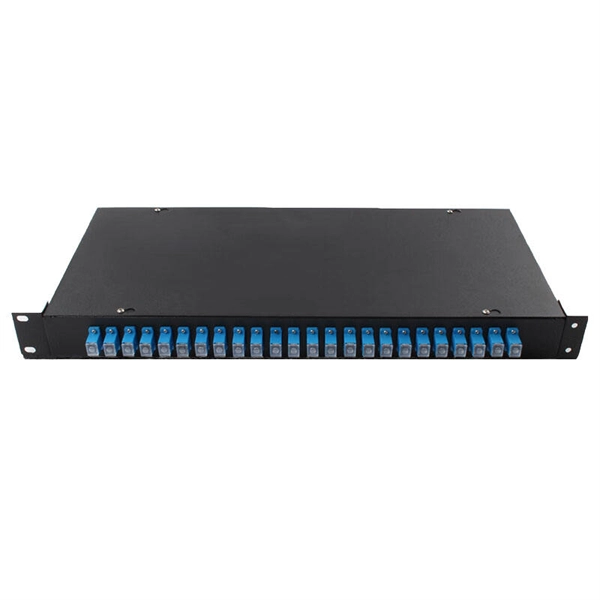
An optical amplifier repeater is a device in fiber-optic communication that amplifies or regenerates optical signals to extend transmission distance, either by direct optical amplification or by converting the signal to electrical form for regeneration.Overview
Optical signals transmitted over long distances in fiber-optic networks experience attenuation, dispersion, and noise, which can degrade signal quality and make detection difficult. To maintain signal integrity, devices such as optical amplifiers and optical repeaters are used .
Optical Amplifiers
An optical amplifier directly boosts the optical signal without converting it to an electrical signal. Common types include erbium-doped fiber amplifiers (EDFAs) and Raman amplifiers. Advantages of optical amplifiers include:
- All-optical operation, which reduces latency and avoids electrical conversion .
- Cost-effectiveness, as one amplifier can handle multiple wavelengths in WDM systems .
- High bandwidth potential, supporting high data rates. However, optical amplifiers also amplify noise along with the signal, which can accumulate over long distances and limit performance if placed too far apart .
Optical Repeaters
An optical repeater (or regenerator) converts the incoming optical signal into an electrical signal, processes it to correct errors, reshapes pulses, and then retransmits it as an optical signal. This process is often called optical-electrical-optical (OEO) regeneration . Key features include:
- Signal regeneration, which reduces distortion and noise accumulation.
- Longer spacing between devices compared to amplifiers, making them suitable for very long-haul links .
- 3R classification: Reamplification (1R), reshaping (2R), and retiming (3R) of pulses for improved signal quality . Drawbacks include higher cost, complexity, and latency due to electrical conversion and processing .
Optical Amplifier Repeater Concept
The term optical amplifier repeater can refer to devices that combine aspects of both technologies. In modern long-haul systems, optical amplifiers have largely replaced OEO repeaters because they are simpler, more cost-effective, and can amplify multiple wavelengths simultaneously in WDM networks . All-optical regenerators are also being developed to provide signal regeneration without electrical conversion, improving power efficiency and integration into optical networks .
Summary
- Optical amplifiers: Directly amplify optical signals, simpler, lower latency, but amplify noise.
- Optical repeaters: Convert to electrical signals, regenerate and retransmit, reduce noise, suitable for very long distances, but more complex and costly.
- Optical amplifier repeaters: Can refer to either all-optical amplification devices or hybrid systems, often used in WDM systems to extend reach efficiently. These devices are critical for maintaining signal integrity and enabling reliable long-distance fiber-optic communication.